
I am very sad to have to report that Ruth Hampel has passed away - wonderful woman, mother, grandmother and great grandmother to a large clan and World War Two Survivor who shared her story (as well as her recipes) with me for this book.

Irris Makler with Ruth Hampel Melbourne 2019
I always loved this photo of Ruth on the day she received her copy of Just Add Love. I also always loved talking to her, in general, because she was so stylish, spirited and smart, and also because as a former Moscow correspondent I loved talking to someone who could describe 1930s Moscow and St Petersburg - you don’t find many of them any more - as well as everyday life in Stalin’s Russia.

Amanda Hampel and Ruth Hampel, Melbourne 2019
Amanda Hampel is married to Ruth’s grandson and a true granddaughter to Ruth, by love as well as marriage. She was also the graphic designer on this book and so we are all entwined together and I know Amanda is heartbroken today, on the first day of a new Jewish year, and as Amanda wrote to me, “the first day of the new Hampel world.”
I send my condolences to all Ruth’s extended family and am reposting this story, as it was written more than 7 (!) years ago now. I also like to read it now, still written in the present tense.

Ruth Hampel, letting great-granddaughter Siena do all the work!
RUTH
Ruth is stylish, well-informed and a pleasure to be with. She has a welcoming smile, an extraordinarily precise memory for a person of any age, let alone someone in their 80’s, and it’s lovely to sit in her kitchen, eat her wonderful food and hear her stories.
“Cooking for me was a joy. I still enjoy it and still cook for myself. Klops. Veal, borscht, strawberry tart, poppy seed cake from my Viennese friends, almond torte at Passover.”
Ruth is the matriarch of a large, successful family, all the more startling when you know her tough beginning.

Ruth Hampel holding her latest great-grandchild, and surrounded by family at a 'small' Friday night dinner in Melbourne, at the home of her son and daughter-in-law, Alex and Sue Hampel.
ONE FOR ALL AND ALL FOR ONE
Ruth’s story is about idealists whose hopes and dreams were brutally betrayed.
Ruth comes from a German Jewish Communist family, ‘true believers’ who moved from Germany to Russia in the 1930’s to Build Socialism - cue patriotic Soviet marching music, black and white footage of vast factories and electricity plants, and statues of Lenin as he hurried to change history, with an explanation of how Bolshevism was creating a New Man.

Russian worker building Magnitogorsk, the largest factory town in the Soviet Union, 1930. (photo: Dimitri Bebabov) Posters below extolling the "heroic working class and collective farmers."


In a way that’s hard to imagine now, in our ironic cynical age, the early 20th century was awash with idealism. Idealisms, in fact. People “believed” in Communism, and also Fascism, and their power to change the world.
Ruth’s family soon paid dearly for their beliefs. Soviet Leader Josef Stalin turned on them as he did on home-grown idealists, crushing ‘traitors, spies and enemies’ in orchestrated attacks against hundreds of thousands of innocent people.

'Long live world Revolution!' Bolshevik rally, Red Square Moscow. The poster of Stalin says, 'Our Brigadier'.
Many of Ruth’s family who went to Russia were killed by Stalin; many of the family who stayed behind in Germany and Poland were killed by Hitler.
Looking back, Ruth says, “We had the madness from both sides.”
RED DIAPER BABY
Ruth is one of an increasingly small number of people who remember day-to-day life in Stalin’s Russia.
She was born in Germany in 1930, the daughter of Max and Stella Fuks. When she was 10 months old they moved to Leningrad, the most beautiful city in Russia, to become part of the great Bolshevik experiment.

Ruth's family photo album
Ruth’s father encouraged his youngest brother Sam to join him in Leningrad, supporting him while he studied there. Another branch of the family was in Moscow.
It was one big happy Red family.

A family group, Ruth's parents Stella and Max at the front.
LENINGRAD ELITE
Ruth’s father worked as an engineer at a factory with 90,000 employees, the Voroshilovsky Zavod. Her mother was a translator.
They were initially treated well. The Soviet state provide jobs, a nanny and an apartment downtown, at the “Foreigners House” in Dyestskaya Ulitsa – Childhood Street - a four story building housing hundreds of the international Communists who threw in their lot with Russia.
The foreign Communists were spared the restrictions of ordinary Soviet life – no travel limits and long queues for them.
“My family was very privileged when we came to Russia. I had a German speaking nanny and went to a German speaking kindy. We could go downstairs and eat whatever we wanted in the building's canteen. We could buy in the “closed” shops, which were for high ranking Communist Party members only. We could holiday anywhere in the Soviet Union. We had tickets to any theatre of ballet performance. We were really the elite.”
Stalin regarded their presence as a propaganda coup. He described socialists and liberals in the West as Useful Idiots, which captures his real views about them. But Stalin was also suspicious of the foreign Communists and kept them together in one place – as he did with other Russian groups - so they could be monitored. (The Secret Police did the monitoring/enforcing. They were known by a series of names. From the 1920s, they were the NKVD; but Ruth refers to them as the KGB in her interview, so I will too.)

Leningrad canals, 1930 when Ruth's family arrived. (Photo: Ralph Barltett)
1936 - THE PURGES CLOSE IN
This privileged, meaningful life continued till about 1936, when Ruth’s father took Russian citizenship.
“The day my father became a Russian citizen, before he made it back home, the authorities already commandeered one room in our apartment – the kitchen – and wouldn’t let my mother take anything out.”
On the very day! Looking back, it was also a poor time to become Russian because the ‘Purges’ of all levels of Soviet society were gathering momentum. People accused of being traitors and spies began disappearing from their homes.
“I remember my little friends that I used to play with, one friend’s father was taken away in 1936, in broad daylight, his hands cuffed behind his back and we children were standing watching. It was terrible. After they took him away everyone kept to themselves except my mother. She went to visit to the woman left behind with her daughter.”
The gloves were coming off. Historians currently accept that between 1936 and 1938 around 1.3 million people were arrested; around 680,000 of them were shot.
“That was summer, August, and a year later they came for my father.”

Normal life went on in Leningrad in the 1930s as the Secret police arrested high-ranking members of the Communist Party, the Army, factories and universities. Ruth's father was executed in these 'Purges.'
1937
“They came with a warrant for the arrest of my father, my mother, my uncle Sam, who lived in our apartment, and even my grandmother, who was visiting – a foreigner had to be a spy…” Ruth explains bitterly.
Ruth’s father had persuaded himself that those being arrested were what the leadership described them as: Enemies of the People. As far as Ruth could see, he didn’t believe there were wrongful arrests – or if there were a few, Max didn’t believe they would ever come for him.
“My father did not believe they would arrest him, because he was a real Communist, a dinky di Communist, and he couldn’t imagine he would do something wrong. He didn’t believe it right up to the second that he heard the footsteps of the 2 KGB officers. It was 7.00 pm, they stopped outside the door and knocked, and he said, ‘They’ve come for me.’”

Ruth's father Max Fuks, in a photo from her album
"I'VE NEVER FORGOTTEN THE DATE - 3 SEPTEMBER 1937"
They took him away. Ruth was 7 years old. Her father Max Fuks was thirty four. She never saw him again.
“My father was executed 17 days later. I only found out in the year 2000, when a cousin who had some connections got me his death certificate.”
In the intervening 6 decades, there was silence from Russian authorities. And even 63 years later, Ruth still needed 'connections' to get the facts.
“On 30th of September – which we now know was 10 days after they killed my father – they came for my mother. They took her away, like with my father, we didn’t know where.”
ENEMIES OF THE PEOPLE
In less than a month, 7 year old Ruth lost both her parents. Other children in this situation were taken to Soviet orphanages for children of Enemies of the People. There, dubbed the 'Littlest Enemies', they were treated harshly and turned against their parents by the State.
Ruth was spared this fate by the quick thinking of her uncle Sam Fuks, her father’s younger brother who lived with them.
“They would have arrested my uncle Sam at the same time but by a miracle he had a 24 hour travel pass. How he got it, I don’t know. It was 11 hours by train to Moscow and back, so he took me, stepped on the train heading to Uzbekistan, got off at Moscow, dropped me on his sister’s doorstep, kissed her and turned around and went back to Leningrad, so he wouldn’t be in breach of his pass."
"The moment Sam stepped off the train, the KGB were on both sides of the carriage door, waiting for him.”
MOSCOW
Ruth lived in Kolkhoznaya Ploschad - Collective Farm Square - with her Aunt Rosa and Uncle Max and their daughter Sonia. She sees it as her great good fortune that they took her in.
“It was a real house, with real love. My aunt adopted me, she had to or they would have put me in an orphanage, but without changing my name, it took 3 months till they let me go to school.”
And meanwhile, they still had no idea where Ruth’s mother Stella was.

Ruth's mother Stella as a young woman in Germany, before she moved to Russia to help build 'the Worker's Paradise.'
MOTHER
The Soviet dictatorship was an odd mix of brutality and bureaucracy. If they didn’t kill you immediately, the Secret Police had to have a “reason” for your arrest, and so they needed you to sign a confession.
Stella was held in a Leningrad KGB cell and told that the charge against her was that she had plotted with Russia’s enemies to poison Leningrad’s water reservoirs in case of war.
“My mother, who couldn’t kill a fly! It was ludicrous. So she didn’t sign that confession. There was no court, they gave her a piece of paper and said sign, but she wouldn’t. There were about 80 women in the prison arrested at the same time, and those who didn’t sign were subjected to the “Standing Torture”. It’s a form of sleep deprivation, where they woke you at night, and made you stay awake standing. When you fell asleep from exhaustion you were hit on the calves with a chain to wake you up. After 5 nights of that my mother couldn’t take it any longer and she said ‘Alright, I’ll confess.’ They gave her a piece of paper, all typed up; it was already prepared.”
Once she signed, Stella was sent to a prison in Central Asia.
“We had no idea of any of this, until early in 1938, we received a postcard. My mother wrote, I’m alive, in Kazakhstan.”
Stella had been in prison for 4 months at that stage. She would stay a prisoner for 4 years.
UNCLE SAM
Sam the young uncle whom Ruth loved was accused of “sabotage” - a favourite charge at the time, along with “wrecking”. Ruth says he was denounced by a fellow worker at the factory.
Denunciations were a feature of the Purges, with people naming each other in false confessions during interrogations; the more cunning also named people to have them removed, so they could take their jobs.
Sam was initially sent to prison in Uzbekistan.
Ruth’s family only found this out when his fiancée told them.
“She came to visit us in Moscow. She was there to get a series of travel documents so she could get to Uzbekistan to see Sam. By the time they gave her the travel passes and she reached Uzbekistan he had already been sentenced to the Gulag, to the network of slave labour prisons, and was on his way to Archangelsk in the Arctic Circle.”
THE KGB AND RUTH
In a short space of time, Ruth had lost the 3 most important adults in her life, and had to adjust to her new circumstances. But even a child was not immune from being menaced by KGB.
They kept an eye on her the whole time – and made sure she knew about it.
She remembers that in 1938, about a year after her mother was taken away, 2 KGB officers came to the yard where she was playing near her home.
They always greeted her by name. And the exchange always followed a similar unsettling pattern.
“Hello Ruth! Do your aunt and uncle feed you? Do they beat you? Come with us!”
Ruth said her aunt and uncle were good to her and ran home. She was 8 years old.
“That would happen quite often. They would stand watching me and then they would corner me and try to persuade me to go with them.”
When I ask why they did this, rather than just taking her, which they had the power to do, Ruth says she believes the purpose was intimidation.
“They were harassing me and if I would have said something wrong then through me they would have taken my aunty and my uncle you see. I think it had something to do with my uncle’s job too, he had a high position and they wanted him to know that they hadn’t forgotten there were Enemies of the People in his family, and that they were watching him, too.”

Ruth's Aunt Rosa and Uncle Max adopted her after her parents' arrest, so she wasn't sent to a State Orphanage. By the late 1930s, so many Russians had been arrested as 'Enemies of the People' that the Orphanages were full of their children, dubbed the 'Littlest Enemies.'
SAM'S LETTER
That same year, 1938, when Ruth’s uncle Sam was in a cattle train on the long journey north to prison in the Arctic he dropped an envelope onto the tracks, hoping someone would pick it up and mail it to his Moscow family.
On it he wrote, ‘If you find this, would you kindly send to this address in Moscow. Have pity on me, I’m going to Archangelsk.’
“And somebody posted that letter, and it reached us, so at least we knew his fate,” says Ruth. “And he sent us a photo from there…”
Ruth’s voice cracks with tears as she remembers the uncle she loved, whose quick thinking saved her from being dumped in a State Orphanage.
“When they sent our cards back to us, the ones we wrote to him, that’s how we knew Sam had died. It was during the War, 20 February, 1942,” Ruth says sadly.
Sam had just turned 30. He was one of millions of Communists killed by their government, just when it needed loyal citizens to fight the biggest war on its own soil in its history.
“Stalin was a megalomaniac who decided he could do without all the foreigners and next came the Russians. In our apartment building we had French, Germans, English, Czechs, and as far as I know every man was taken… All the idealistic men who came to build the Workers’ Paradise,” says Ruth.

Soviet leader Josef Stalin visits one of the first projects built by slave labour, the White Sea Canal, in 1938. The small man to his right is Secret Police Chief Nikolai Yezhov. Known as the 'Poison Dwarf', he oversaw the Purges. Within months of this photo being taken, Yezhov was himself purged and executed. After that, long before the invention of Photoshop, Soviet historians painstakingly removed him from the photograph.

Same photo, no Yezhov!
RUSSIA AT WAR
Stalin was stunned when in June 1941, Germany attacked Russia. He had signed a pact with Hitler, and did not expect this betrayal. It’s strange if you think about it. Stalin saw betrayal all around him within the Soviet Union and by 1941, he'd killed hundreds of thousands of his own citizens; millions if you include the victims of the Ukrainian famine. But he didn’t suspect Hitler.
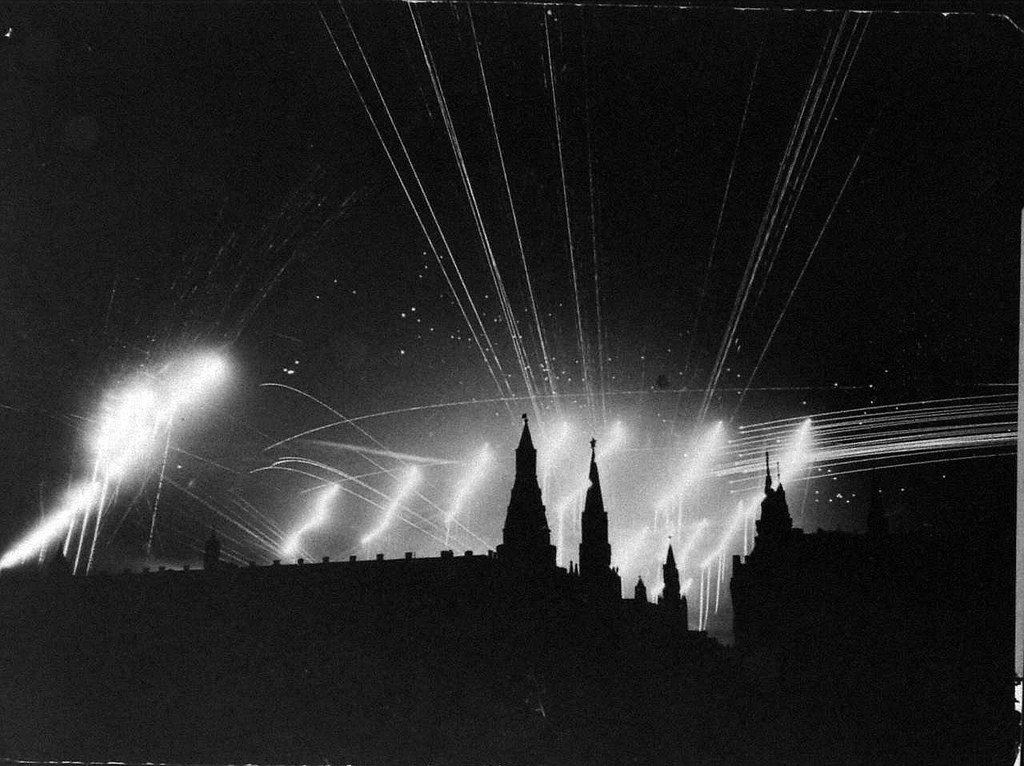
Moscow under attack, 1941. (Photo: Margaret Bourke-White) Civillians, including Ruth and her family, were evacuated to Central Asia for safety, when it looked like Moscow might fall.
Russia was not prepared for battle. Hitler massed the largest force in the history of warfare for the attack of June 1941. Within weeks German soldiers had overrun Ukraine and Western Russia, and by autumn they had reached just 8 kilometres from Moscow.
Ruth remembers people being frightened, especially when the government announced that it would no longer remain in Moscow; by October 1941, civilians were being transported out of Moscow for their own safety - mostly to Central Asia.

"The Soviet People stand with Moscow" - Soviet war time poster
“My aunt decided that she and her daughter Sonia and I would go, because if we were in Kazakhstan, we would be closer to my mother and I might be able to see her. The night before I left, I went to say good bye to my school friends, and as I walked out, who was standing near the door but 2 KGB officers.”
KGB
The exchange followed a familiar pattern.
“Hello Ruth! Where are you going?”
“To Kazakhstan, with my mother.”
“Why are you going to Kazakhstan to your mother, when she’s a traitor?”
“I’m not going to my mother, you know that my mother lives opposite you see the light on, that’s my mother. My aunt and uncle have adopted me, I’m not going to my mother, I’m going with my new mother.”
And she ran home, heart pounding.
Ruth never told her family about this exchange, until more than 2 decades later when she met her cousin Sonia in Paris. Sonia, by then a scientist who had been awarded the Order of Lenin, could not believe it.
Looking back now, Ruth can't believe it either.
“With Russia at War, and in fact at that stage losing the War, in that desperate situation they were still wasting time with me, an 11 year old child, whose parents were Enemies of the People.”

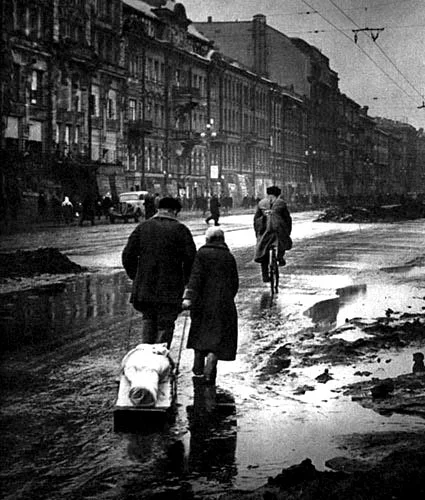
Gun Battery in Central Leningrad. The city was besieged by German troops for almost 3 years, which led to mass starvation and enormous suffering. One third of the city's population, more than 800,000 people are estimated to have died - around 600,000 starved to death. Below left, too weak to stand, people crawl on the snow to receive rations. (photo: Vsyevolod Tarasevitch) Below right, 'On the way to the funeral, 1941' (photo: Boris Kuroyarov)

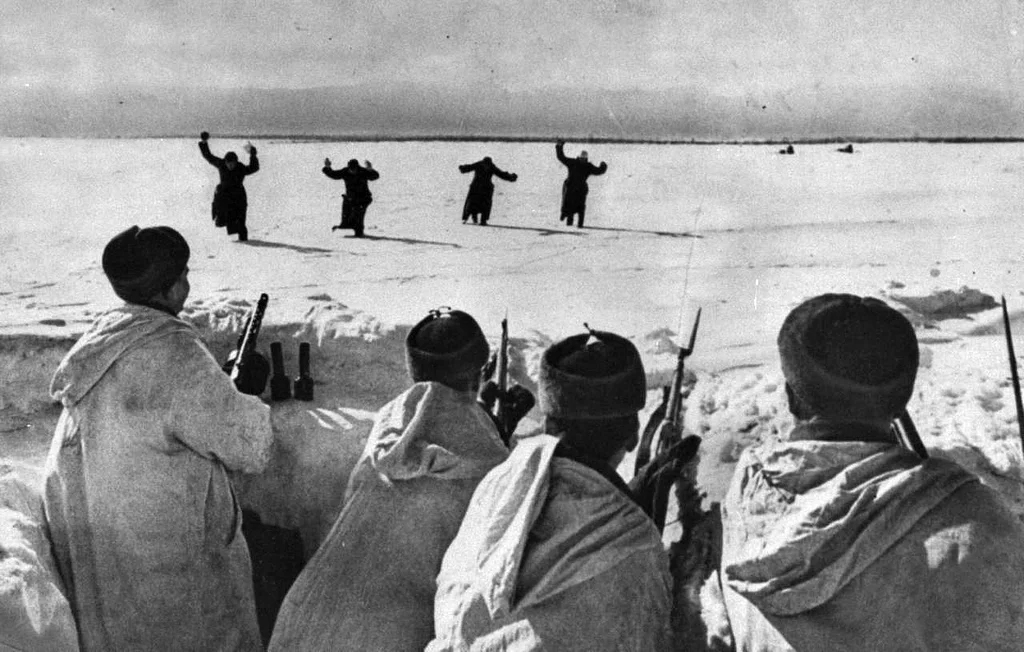
German soldiers surrender outside Moscow, winter 1941. More soldiers fought on the Eastern Front than in all the theatres in World War 2 combined.
KAZAKHSTAN
Ruth’s mother Stella was no longer in prison but she was sentenced to stay in Kazakhstan for a further 5 years.
“My aunty and Sonia and me went to Kazakhstan, to the town of Novoesilo. It was kind of the middle of nowhere, 100 km from 2 big cities of Almaty and Jambu. There was no high school there for Sonia, so Aunt Rosa decided to move to Kirgizstan, so Sonia could keep studying.”
They left Ruth behind with her mother.
It was not easy for either of them.
“It had been 4 years. I was very attached to my aunt. My mother was 37, she had no husband, she was sleep deprived, and badly affected by her prison experience. She was not the same woman she’d been before," Ruth says sadly.
“I was headstrong, she was meek. My mother was not capable in reality to look after a child after her experiences in prison. It broke her on some level. I couldn’t comprehend it and held it against her. It was only 60 years later, long after my mother died, when I read a book called The Whisperers by Orlando Figes, about the people who survived the Stalin time, that I understood her more.”
SWAPPING ROLES
“My mother needed a man around her not a child. So at 13, I sort of became a provider. We were both sick. I had typhoid fever and malaria. She had tropical malaria and I had to look after her. In her delirium there was always one cry, ‘Please don’t let me die here, get me out of here.’ So I stopped school. I had to, in order to wash, clean, cook and provide for us. Sew clothes. Sell at the markets. Feed and milk our goats. We had 3 goats. My mother said, ‘Don’t sell a goat – this is our investment.’”
By 1944 Germany was starting to lose the war and Ruth’s aunt Rosa and her cousin Sonia returned to Moscow.
Ruth's mother wanted to escape from Russia altogether. She didn’t know her husband’s fate, but believed he was dead, and she didn’t want anything more to do with Communism. She and Ruth began the long journey west. As a political prisoner, Stella couldn't go within 100 km of any large town, so if anyone asked, they said they were headed for a small town 120 km from Moscow. But in fact, they were hoping to re-join their family in Poland and Germany.
They didn’t know then that most of their relatives had been killed by the Nazis.
LEAVING RUSSIA
In June and July 1944, Ruth and her mother were travelling on trains for thousands of miles, across the vastness of war-torn Russia.
“We would buy at one station, apples or herring, and sell at the next, to make money to keep going,” says Ruth.
Out of their windows, they mostly saw devastation, reflecting the scale and ferocity of the battles on the Eastern front.

A statue from a Soviet children's park, outside Stalingrad, 1943 (Photo: Emmanuel Everikhin)
They thought things were bad, and then they reached Ukraine.
“The 800 miles from Donetsk back across the Ukraine, there was nothing, not a thing, it was all destroyed. There was not a village, not people, not cows, not a dog or a cat. We were told that the Germans had razed it to the ground. The only life of any kind was Kurds and Tartars walking out.”
UKRAINE
By August 1944 they were nearing the front.
“When we reached Rovno in the Ukraine, they stopped the train and took all the civilians off. They said, ‘The frontline is ahead, we can’t go any further. You have to stay here and fend for yourselves as best you can.’ At that time, there were also nationalist Ukrainian gangs who roamed the countryside, and they were slitting the throats of Jews. (These followers of Ukrainian nationalist Stepan Bandera were called Banderovs.) So we stayed in the railway station all night – lucky it wasn’t winter,” Ruth remembers.
“In the morning we woke up and there in the corner was a man praying. For me, I couldn’t figure out what this prayer shawl was or this box on his forehead. Now I know that these are Jewish symbols, but then I had no idea about anything religious since I was a Soviet child. But my mother knew.”
Stella waited till he finished praying before she approached him saying, “I’m Jewish, can you help us?”
He replied, “Go to the market, find a bowlegged man there, he helps Jews.”
“His name was Mr Melamed. I’ll never forget it because he did help us,” Ruth smiles.
ROVNO
Most of the Jews of Rovno – 25,000 people - had been annihilated by the Nazis when they first conquered the area in 1941. Mr Melamed had escaped and only recently returned.
He found Stella and Ruth accommodation and helped them find work.
“He said go to this woman, she will give you something to sell, then go to the bazaar and sell it. But by the time I got to the bazaar after school, everything was finished. So school came second, living came first and I gave up after the first semester. Mr Melamed gave us credit and arranged everything."
"My mother worked in a factory, sewing padded jackets for soldiers. She had to work. Otherwise they would have sent us out to the country, and there the Banderovs would have slit our throats, even though the war was ending, it didn’t matter.”
One thing that was surprising to Ruth was the food. She'd learnt to cook in Kazhakstan but there was much more fresh produce in Ukraine.
"Peasants brought it to the markets and there was always plenty and fresh, including bread and butter. Meat and milk in abundance. Butter in huge rounds. More than a kilo, more like the size of a football. To me it was an eye-opener. I hadn’t seen that much food even in Moscow before the War, where we had to to stand in line and queue for food."
OUT OF THE USSR
Ruth and her mother lived like that till November 1945. Stella gathered enough money together to buy a “clean” passport, with no reference to her status as a political prisoner. Ruth, not yet 16, was included on her mother’s passport.
“So we were both on a passport that said ‘Born in Warsaw’ which was quite lucky, because starting October 1945, they were sending the Poles back to Poland. My mother met 2 Polish sisters who signed that they’d known us in Warsaw. No one was really checking. Their word was good enough. We got papers!”
Stella and Ruth left for Poland, hoping to see her father's family, who had been sent back to their hometown of Lodz by the Nazis.
“But by the time the train got to Poland we understood that there was no one left. At first, we didn’t believe that the Germans could do such terrible things – particularly not my mother who actually was German. Once we reached Rovno, we realised things were getting grimmer. In Poland we accepted the horrible truth. There were no Jewish communities anywhere.”

Jewish women in the village of Kerch in the Crimea in 1942, searching the dead for their men, shot by German troops. One of the most famous photos by great Soviet photographer Dmitri Baltermants.
So to put it starkly, Ruth’s father Max, the idealistic son, was executed by Communists and his parents were murdered by Nazis.
“That’s why I say we had the madness from both sides,” Ruth sighs.
POLAND
There was a possibility that Stella’s parents were still alive, as they had spent the war in France. But Stella had a mental block and couldn’t remember their address. In the meantime, Ruth and Stella were in the Polish town of Katowice, living in a house that had once belonged to Jews.
“We decided that we would go to Palestine. I was in a special group in Katowice called Hachshara. And suddenly in March 1946, my mother remembered her parents’ address. She wrote them a letter, but it turned out they’d moved, so it was some time before we got a reply.”
Then one day Ruth’s mother said to her in tears, “My parents are alive, and Aunty Jenny is alive.”
FRANCE OR PALESTINE?
Ruth’s grandparents sent a telegram saying they wanted them to come to Paris. But by then Ruth and her mother were on the list for Palestine, about to smuggled out of Poland.
In July 1946, as they were leaving with the Zionist group, there was a pogrom in the Polish town of Kielce.
Locals turned on Jews who had returned to their home town after surviving the concentration camps. Forty two people were killed. Barely a year after the Holocaust, it was a shock to the tiny remaining Jewish population of Poland, and clinched their determination to leave. Ruth and her mother were on a train on their way out of Poland when they heard about the pogrom.
“The Poles in the carriage said ‘Ha, they’re killing Jews!’ while my mother and I sat there shivering. We get off towards the Czech border.”
A complex journey followed, involving hiding in trucks, as well as walking at night to reach Vienna, then Germany and then Switzerland. Ruth and her mother became separated crossing over the Swiss- French border.
“She was in Dijon, and I was in Marseilles. That was where we were meant to board the boat for Palestine. Instead my mother came to take me to her family in Paris. The Zionist group which had smuggled us out of Poland were furious. They said, ‘Get out! We could have saved the lives of 2 other people.’”
WE'LL ALWAYS HAVE PARIS
In Paris, Stella reconnected with old friends who offered Stella and Ruth a room in their Paris apartment. It was one of the few in their building which had running water – cold running water.
“What was Paris like? You’re asking a 16 year old girl who had come from complete devastation. Paris for me was heaven!!!" Ruth exclaims.
"There’s a German saying ‘Heaven is full of music’. I was free, there was no KGB. I wasn’t afraid. I was coming and going as I pleased. I got friendly with one of the daughters of my mother’s friend Marta and we went to concerts, operas, tea dances on Sundays, there was a Jewish club we went to,” Ruth remembers happily. “Even though we were poor as church mice, it was heaven. I had one dress which the UN Refugee Agency gave me, and that’s what I washed and pressed when I was going out. We each had a change of underwear, but otherwise only the clothes that we had on.”

Ruth in her late teens.
MATCHMAKER, MATCHMAKER
Early in 1948, Stella’s friend Marta returned from a visit to Italy with a photograph and the immortal words, ‘Ruth, I’ve got the boy for you.’
“I’d just turned 18, and had no intention of getting married. But I did take a look. Then I said, ‘Marta keep the photo, he’s too handsome. I don’t want every skirt chasing after him.’”
Marta didn’t say another word. 2 months later she invited 'the boy' to Paris.
DAVID
David Hampel was the son of German Jews who had survived the War in Switzerland and Italy. He was 26 years old, tall, dark, handsome and sophisticated. He met Ruth at an afternoon tea at Marta’s. She introduced them and left.
David swept Ruth off her feet. She says she knew from the first moment.
“He was knowledgeable. Well, he was 8 years older. I looked for not a father figure, but a man. After all I’d been through, I didn’t want a boy.”
He was equally struck by her. 5 days later he proposed.

Signing the registry at their civil marriage ceremony in Paris.
Ruth didn’t say yes straight away. She said she’d think it over, and let him know the next day.
“His family was going to Australia. Marriage meant going with him and I had a lot to lose, I was giving up Paris, a family, my mother, to go to something unknown. I went home and I didn’t want to be influenced by anybody, so I didn’t tell them until I'd said yes to David. To the last day of his life he was kidding me that I shortened his life by 24 hours by not saying yes on the spot.”
Once Ruth accepted his proposal, David added one more condition. He wanted her to keep a kosher home.
“I was in love, I was 18, so I said yes. I’d been hungry, once you had food, it didn’t matter to me if you prepared it this way or that way. He was very learned, he knew Talmud, he could take it on with any rabbi. I didn’t know much about it, but I embraced Judaism and my husband made it possible for me to feel Jewish and proud.”

Ruth Fuks and David Hampel marry in Paris in July 1948, 3 months after they met. The bride was 18, wearing a borrowed dress.
David returned to Italy, coming back to Paris in June, “with his parents and the ring”. On the 11th of July 1948, Ruth wearing a borrowed dress, they married.
David’s ticket to Australia was for the 23rd of July. Ruth’s visa for Australia only arrived on the morning he was meant to fly out.
“In those days you couldn’t pick and choose your passage, so he went. I was meant to follow in a fortnight.”
But that didn’t happen. After being married for only 12 days, a series of obstacles kept them apart for months. Finally, following a 6 day (!) flight, Ruth landed in Australia 23 January, 1949. It was 6 months since they had last seen each other.
“The flight landed early. I called David. He said just stay there, we’ll come and get you. And I said no I’m not waiting one more minute, I’m coming to you. We almost had a fight! I jumped in a cab, and we met on the corner of Balaclava Road and Hotham Street. I said stop the car, stop, stop – and that was my arrival.”

Ruth with her 3 sons, Max, Alex and Danny
David and Ruth had 3 sons and built a prosperous, happy life together, staying around those same Melbourne.
“It was a wonderful marriage. 58 years of wonderful marriage. My mother’s friend Marta, the matchmaker, was right. When I saw her in Paris the last time, I thanked her.”

COOKING
Ruth cooked all her married life. She has passed on her recipes to her sons, their wives, her grand-daughters and now her great-grand daughters.

Ruth with her grandson's wife, Amanda Hampel and great-granddaughters Siena and Taylor.
"I learnt as I went. I lived with my mother-in-law for the first 3 years after I came to Australia, so I also learnt from her. She had lived in Italy so she cooked some Italian food, as well as Polish and Jewish. In those days we had to pluck the chickens and make our own noodles and farfale," says Ruth.
"I also made friends who were good cooks. We got in with a Viennese crowd, they were good cooks, especially the Adlers, she was incredible. An incredible baker. I was inspired by them because we were going to each other’s for dinner. There wasn’t much going on on Sundays in Melbourne then. In fact after midday Saturday, Swanston Street was empty. You could shoot a camel there."
SUMMER FRUIT
This tart comes from Ruth's mother Stella. The pastry is crisp, the fruit sweet and the glaze tangy – perfection! It's not a rich desert, but if you eat it close to when you prepare it, you'll swear you’ve never made anything so light and delicious in your life. The original had strawberries, but if you can’t find them, use whatever you can find that’s fresh. Figs, nectarines, apricots or plums.
The fruit is fresh and not cooked, which gives this tart its special texture and flavour.
TIP: Ruth uses sour cherries (which she buys in a jar) so that she can make this tart all year round; if she uses plums she will bake the tart twice, to cook the plums.
I have tweaked the recipe slightly, reducing the amount of sugar in the pastry. Otherwise, it's as Ruth's mother made it.
Stella's Stellar Summer Tart
PASTRY
225 gm / 1 ¾ cups plain flour
125 gm / 4 oz unsalted butter
50 gm / 4 tablespoons sugar
1 packet vanilla sugar
½ teaspoon salt
1 egg
1 egg yolk
2 Tablespoons cold water


METHOD
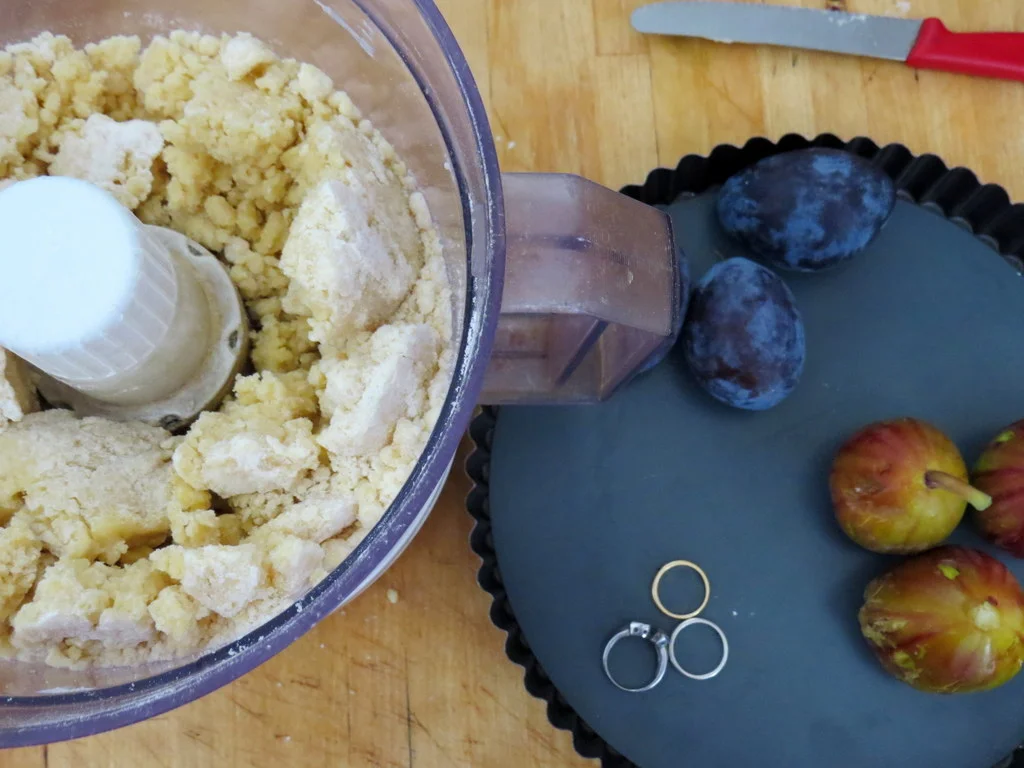
1. Mix all the ingredients except the water in a food processor. Add the water slowly. Don’t over mix! When dough has come together, shape it into a ball, cover with plastic wrap and leave in the fridge, anywhere from 3 hours to overnight. (I left it for 2 days and that was also fine.)
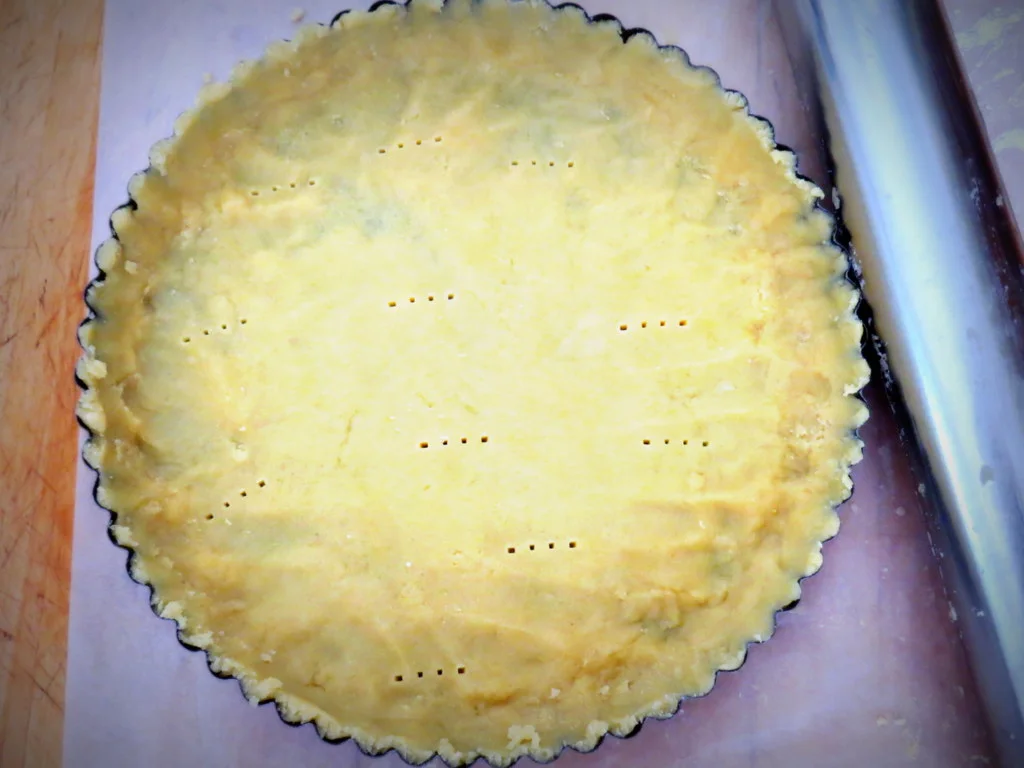
2. Grease a 24 cm pie tray with a removable base. Remove dough from fridge and roll out onto the tray. Prick the base with a fork, place in the freezer for 10 minutes or so while you heat the oven to 180 degrees.
3. Cover with baking paper and beans and bake for 20 minutes until golden. If you want it super-crisp, put your oven on a setting that will let it cook from the bottom too for about 10 minutes.
4. Remove and cool.


filling and glaze
3 punnets of small strawberries or whatever fruit is in season
1 tablespoon potato flour or cornflour
1 tablespoon sugar
1 cup of juce from a jar of sour cherries. You can substitute fresh citrus juice. If you use lemon or lime juice, you will have to increase the sugar!
Optional: 1/2 a teaspoon cardamom, nutmeg and/or any other spice you fancy, plus a few drops orange water. Ruth also sometimes adds a little Cointreau

It's proven! Kisses make cooking easier - and tastier.
METHOD
1. Take the small strawberries, or other fresh fruit. Place whole or cut in half, in rows, around and around the pastry base. It's the symmetry that makes this tart beautiful.
2. In a small pot, mix the sugar and potato flour. Slowly add the juice. If you are doing the citrus version, add the extra sugar, and optional ingredients - spices, orange flower water, or Cointreau - now.
3. Bring to boil and when it starts to bubble, turn the heat down to low and cook for another minute, stirring continuously. Let it cool for 3 minutes or so and pour over the strawberries. Voila! Let the glaze set a little in the fridge, then eat immediately.

PLUM FILLING
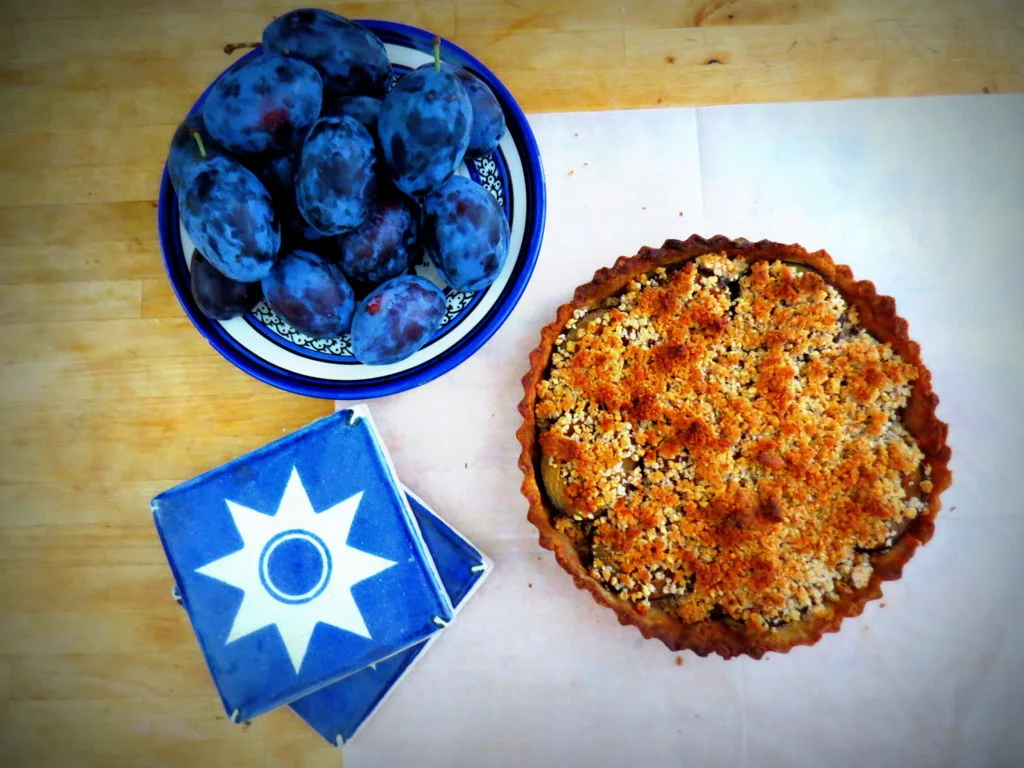
If you would like to use plums, you will have to bake the pastry twice. Once till it turns golden, and then once with the plums so that they cook too. Take 20-25 Angelina plums, halved. Place cut side up around the pastry base, making smaller and smaller circles. Sprinkle with streusel topping, and bake for a further 20-25 minutes in an oven set to 180 degrees.
One word of warning: Plums take a long time to cook, so best to choose ripe ones, or to slice them finely into rounds. I didn't do that the first time and the plums were too large and didn't cook through, so I had to make a second batch!
STREUSEL TOPPING
Mix together until you have made crumbs
50g butter softened
50g sugar
50g plain flour or ground almonds
1 tbsp vanilla sugar
Optional: mix some spices eg cardamom or nutmeg in here too.
By the way, earlier we tried out a lemon curd tart that was the favourite of Russian writer Leo Tolstoy. here on this blog. Interestingly, Ruth mother’s pastry is practically identical to that of the Countess Sophia Tolstoy. Russian bakers seem to know what they're doing!

MElbourne test kitchen
Amanda Hampel in Melbourne was thrilled to be preparing this, since – drumroll – she is married to Ruth’s grandson and simply adores Ruth, known to all the family as Omi. Amanda's idea of a perfect morning is to take her girls over to Omi's to cook. Judging from their reaction, they think it's pretty good too.

Amanda is a gluten free cook, so she used a GF flour, which she mixes herself. Adaptable Ruth now often makes a GF version of this tart too.
“It was always going to prove a little challenging to place the pastry into the pie dish. Patience is required when peeling off the baking paper after rolling - definitely a key point!!” says Amanda.


Amanda’s eating restrictions extend to cherries, so she went the citrus option. She is sometimes - heroically - prepared to cook dishes which she can't eat herself, but not this time!
“I used freshly squeezed orange juice for the glaze because I reaaaaaaally wanted to try this one!!”
She thought she might have made too much glaze, so she rang Ruth to check.
“Omi was so funny, she said pour it over everywhere, and then more! And if there’s any left just add it in and even it up all around. Yeah, she definitely got the point across. Don’t skimp on the sauce! Haha!!”

VERDICT
It was excitement city at the Hampels.
“I was so so excited to eat it!! And my girls are sooooo excited to get home from school today and have a piece!!!”
Luckily, after all that build-up, they loved it.
“Yummmmmm!!! Plus, the citrus tang in the glaze was actually was unbelievable!! My kids thought it was the best tart ever and said as soon as it’s finished I need to make another one ;))”

JERUSALEM TEST KITCHEN
So here in Jerusalem it's already too late in the season for strawberries, but it’s a perfect time for figs!

So that's what I used.
It was a great option. In the glaze, I used lime juice with orange flower water, along with my cardamom, my current "go to" spice, and that was a winner, too.The combination of the ripe squishy sweet figs with that sour sweet sauce was to die for!
I also thought I’d made too much glaze but because I didn’t have Ruth’s advice to slosh it everywhere ringing in my ears, I used it sparingly on the tart, and added the left-overs to some yoghurt. That was also a hit, a magic combination with the tart and the fruit.
VERDICT: A big thumbs up! Make this tart!!!

impact
With these experiences growing up, perhaps it’s no surprise that after police knocked on her door in Melbourne one morning, Ruth started shaking and having nightmares. You carry some things with you forever.
In 2005, Ruth went to Russia with her family. They found the apartment building she'd lived in in Leningrad, which was by then called by its original name of Saint Petersburg again.
"It was now an army barracks, pretty filthy and neglected, but they were friendly and invited me to see the apartment. But I could not go inside, I couldn’t step inside and go back to the last day I saw my father," says Ruth sadly.
Almost 70 years later, it was a wound she could not bear to re-open.

Max Fuks, 1903 - 1937
Ruth Hampel 1930 - September 2026